The Economics of Climate Change — What Inaction is Costing India


We talk about climate change as an environmental crisis. But what if we've been framing it wrong all along? Because for India, climate change is fast becoming one of the biggest economic threats of the 21st century — and the bill is already arriving.
The window to act is narrowing fast. Every year we delay addressing climate change, the economic damage compounds — in our farms, our cities, our hospitals, and our infrastructure. This post is about making that cost visible, because you can't solve a problem you can't see.
The Cost of Extreme Weather
India is no stranger to extreme weather — floods, droughts, cyclones, and heatwaves have always been part of the subcontinent's climate story. But what's changing is the frequency, the intensity, and the price tag. In 2023 alone, India experienced climate-related disasters on 87% of the days of the year — that's only 47 days where somewhere in the country wasn't dealing with a flood, a drought, a landslide, or a heatwave. The economic losses from these events run into tens of thousands of crores every year — in damaged crops, destroyed infrastructure, displaced populations, and lost productivity. The 2023 floods in Himachal Pradesh alone caused damage estimated at over ₹10,000 crore. The Chennai floods of 2015 cost the city an estimated ₹20,000 crore. These aren't once-in-a-generation events anymore — they're becoming the new normal. And every time a flood washes away a road, a cyclone destroys a fishing village, or a heatwave kills livestock, the cost doesn't just fall on the government — it falls on ordinary families who lose their homes, their livelihoods, and their savings in a matter of hours. The question is no longer whether extreme weather is getting worse. The question is how long we can keep absorbing the cost.

The Agriculture Crisis
If extreme weather is the most visible face of climate change, agriculture is where its economic consequences cut deepest. Nearly 60% of India's population depends, directly or indirectly, on agriculture for their livelihood, and climate change is hitting the sector from every direction at once. Unpredictable monsoons mean farmers can no longer rely on the rainfall patterns their families have depended on for generations. Prolonged droughts are depleting groundwater reserves that took centuries to accumulate. Unseasonal rains and heatwaves are destroying standing crops just days before harvest—wiping out an entire season's income in a matter of hours. The numbers tell a sobering story. Climate-related disasters inflict agricultural losses worth tens of thousands of crores every year, through damaged crops, reduced yields, and disrupted rural livelihoods. Rising temperatures are projected to reduce wheat yields by up to 20% and rice yields by up to 10% by 2050, at a time when India will need to feed a population of more than 1.6 billion people. This isn't just a farming problem—it's a food security problem, an inflation problem, and a poverty problem all rolled into one. When crops fail, food prices rise. When food prices rise, the poorest families—who spend the largest share of their income on food—are hit the hardest. Climate change and economic inequality are not separate issues in India. They are deeply interconnected.
The Health Economy
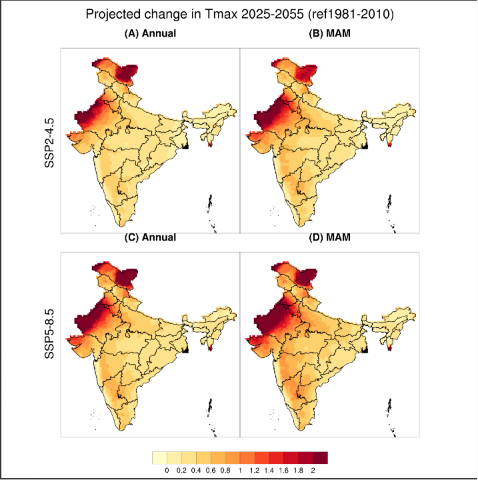
Climate change is making India sicker—and sickness has an economic cost that rarely gets factored into the conversation. India already bears one of the highest burdens of air pollution in the world and is home to many of the world's most polluted cities. The health consequences are enormous, ranging from respiratory diseases and cardiovascular conditions to millions of lost workdays and premature deaths, imposing tens of billions of dollars in economic costs each year through lost productivity and healthcare expenditure. But air pollution is just one part of the picture. Rising temperatures are expanding the geographic range of diseases like malaria, dengue, and cholera into regions that previously had natural climatic protection against them. Longer and more intense heatwaves are increasing heat-related illness and mortality, with daily wage workers, farmers, and construction workers bearing the brunt because they often cannot afford to stop working when temperatures soar above 45°C. Flooding contaminates water supplies and triggers outbreaks of waterborne diseases that overwhelm already stretched public health infrastructure. The World Bank estimates that climate change could push up to 45 million Indians into poverty by 2030, with worsening health, declining livelihoods, and more frequent disasters all contributing to this risk. Think about what that means—not just in human suffering, but in lost education, lost productivity, and lost economic potential for a country that is expected to become the world's third-largest economy. A nation cannot grow its economy while its people are getting sicker, poorer, and more vulnerable every year. Health is not separate from economics—it is the foundation of it.
The Infrastructure Bill
India is in the middle of one of the most ambitious infrastructure buildouts in its history — new highways, metro systems, ports, airports, smart cities, and coastal developments worth hundreds of billions of dollars. But here's the problem — much of this infrastructure is being built for a climate that no longer exists. Roads designed for average temperatures are buckling under record heatwaves. Drainage systems built for historical rainfall patterns are being overwhelmed by the intensity of modern monsoons. Coastal infrastructure worth trillions of rupees is increasingly at risk from rising sea levels that threaten tens of millions of Indians living in low-lying coastal areas by 2050. Mumbai — India's financial capital and home to the country's most valuable real estate — is listed among the world's most vulnerable cities to climate-related flooding. A single severe flood event in Mumbai has the potential to paralyse the entire Indian economy for days. The cost of retrofitting and climate-proofing India's existing infrastructure runs into several lakh crore rupees — money that will have to be spent regardless, because the alternative is watching that infrastructure fail prematurely. And every rupee spent repairing climate damage is a rupee that cannot be spent on schools, hospitals, or the new infrastructure India desperately needs. This is the cruel arithmetic of inaction — the longer we wait, the more we pay, and the less we have left to build the future with.
The Opportunity
So far this post has been about costs—and the numbers are sobering. But here's the part that rarely makes the headlines: acting on climate change is not just about avoiding losses. It's about capturing one of the biggest economic opportunities in India's history. The global green economy is expanding rapidly. Renewable energy, electric vehicles, sustainable agriculture, green construction, and circular economy businesses are among the fastest-growing sectors in the world today, and India is uniquely positioned to lead. India already has the world's fourth-largest installed renewable energy capacity. The government's target of achieving 500 gigawatts of non-fossil fuel electricity capacity by 2030 is expected to create millions of jobs across renewable energy, manufacturing, construction, operations, and allied industries—helping absorb a significant share of the young workforce entering the job market over the coming decade. That means you. The students reading this post are going to graduate into an economy where green skills, sustainability knowledge, and climate awareness are not niche credentials—they are going to be among the most sought-after qualities an employer can find. Beyond jobs, there is the question of innovation. India has a long history of solving big problems with frugal, ingenious solutions—what economists call jugaad. The climate crisis is the biggest problem of our generation, and solving it will require exactly that kind of thinking. The startups, the technologies, and the policies that help India adapt to and mitigate climate change will not just save the country money—they will create enormous wealth, open new export markets, and establish India as a global leader in the industries that will define the 21st century. The cost of inaction is devastating. But the reward for action is extraordinary.
The numbers in this post are not abstract projections from a distant future. They are happening right now — in the flooded fields of Assam, the polluted air of Delhi, the crumbling coastlines of Kerala, and the empty wells of Marathwada. India is not waiting for climate change to arrive. It is already living with it, paying for it, and absorbing its costs in ways that rarely make the front page. The question is no longer whether we can afford to act on climate change. The evidence is overwhelming — we cannot afford not to. Every year of delay is another year of compounding damage, another year of opportunities missed, and another year of burden transferred onto the youngest and most vulnerable shoulders in our society. That means you. As students, as future professionals, as future voters, and as future leaders — the decisions made in the next ten years will determine the kind of India you inherit and the kind of India you leave behind. This is not someone else's problem to solve. It never was. The economics are clear, the science is settled, and the clock is running. India needs people who understand what is at stake and are willing to do something about it. Be one of them.


Comments